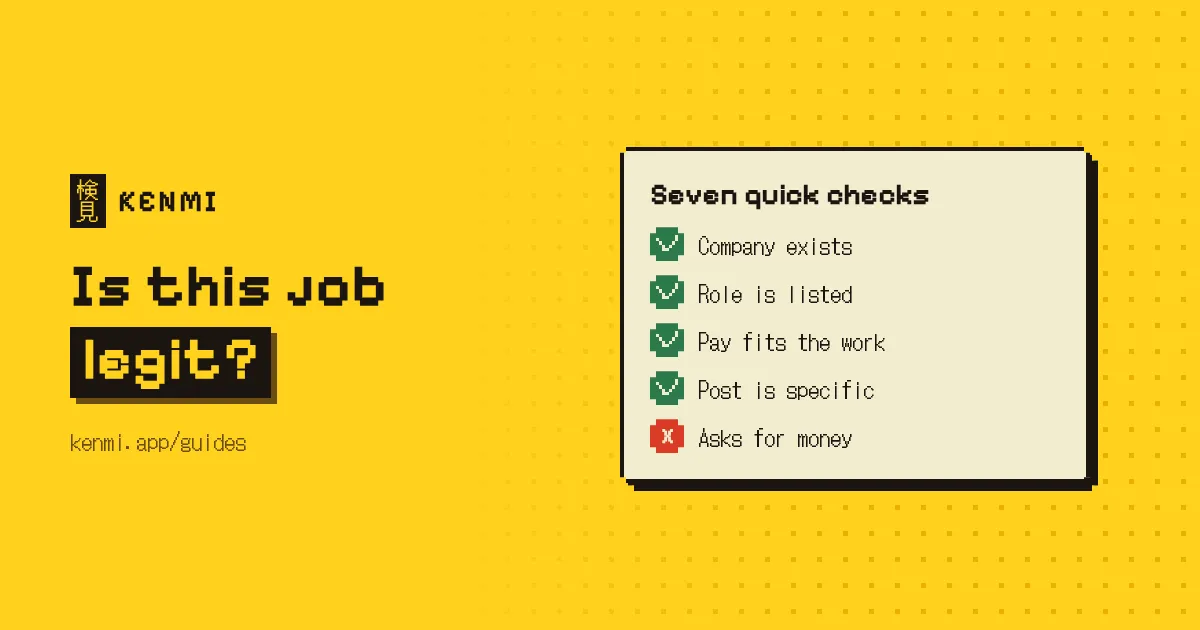
Is this job legit? Check four things. The company exists and lists the role, the pay fits the work, the post is specific, and hiring involves a real conversation with a person. Any request for money, or to move to a chat app early, means walk away.
Why this got harder
Scam posts used to give themselves away with clumsy writing. You can't count on that anymore.
AI tools can now write a convincing job post in seconds, and scammers have noticed. Freelance feeds and job boards carry far more posts than they used to, and a fair share of them are AI-written scams, ghost jobs or low-effort posts that were never going to hire anyone. The same tools have made competition for real jobs heavier, because everyone can fire off a polished application in a minute.
That pressure makes it tempting to apply first and check later. I'd argue for the opposite. The checklist below takes a couple of minutes per post, and it saves you from pouring hours into jobs that were never real.
The seven-step checklist
1. Does the company exist?
Search for the company somewhere other than the job board. A real company has a website, some history and people who visibly work there. A brand new page with no website, or a website that doesn't match the company in the post, is a warning.
2. Is the role listed by the company itself?
Check the company's own careers page for the same role. On freelance platforms there's no careers page, so read the client's history instead, such as past hires, money spent and reviews. Our guide on how to spot Upwork scams explains what to look for on a client profile.
3. Does the pay fit the work?
Pay far above the market for simple work is the oldest bait there is. Pay far below the market for skilled work usually isn't a scam on its own, but it does tell you how the client values your time.
4. Is the post specific?
Real posts describe real work. There's a team, a set of responsibilities, actual tools and actual requirements. A post so vague it could describe any company is often fake, or written to collect applications rather than to fill a seat.
5. Does anyone ask you to leave the platform early?
A request to continue on Telegram, WhatsApp or a personal email before there's any contract is one of the most reliable scam signs on every platform I've used. Once you're off the platform, you've lost its payment protection and its record of what was agreed.
6. Is there a real person in the hiring process?
Automated screening is normal now. A process with no human at any stage that still ends in an offer is something else. I'm suspicious of AI-only interviews in general, and our guide on how to spot a fake job offer explains why.
7. Does anyone ask for money or sensitive details?
Fees for training, equipment or a background check end the check right there. So does a request for bank details or ID before a real contract exists.
What tends to separate real jobs from the rest
The checklist tells you what's wrong with a post. It's just as useful to know what a promising one looks like, and in my experience the strongest signal is simply whether someone is really hiring.
From experience
On LinkedIn, the posts worth my time were usually from smaller companies that clearly needed someone, not from large companies that seemed to be posting for visibility. On Upwork, the clients who caused me trouble usually had almost no hiring history, so there was no bad rating to warn me. In both cases, what mattered was whether someone was really hiring, and polish had very little to do with it.
Smaller companies tend to post because they need a person now. Big companies sometimes post to look busy or to build a pipeline for later, and I suspect a good number of those listings never turn into a hire. Named people help too. If there's a hiring manager or recruiter you can look up and message, that's a good sign. Recent posts beat roles that have been reposted for months.
On freelance platforms, a client's hiring history is the best evidence you have. A long record of hires and spending doesn't guarantee a good client, but no record at all means you're guessing. That doesn't make a new client a scammer. It just means you should protect yourself with clear terms, a defined scope and milestones before you start.
Which scams the checklist catches
Most job scams fall into a few familiar types, and each one trips at least one step.
- Advance fee scams ask you to pay for training, equipment or a background check, so they fail step 7.
- Fake cheque scams send you a cheque, ask you to pay a "supplier" out of it, and then the cheque bounces. Step 7 again.
- Identity theft dressed up as hiring collects your ID, bank details or tax number, which fails steps 6 and 7.
- Off-platform scams move you to a chat app where there's no payment protection, and fail step 5.
- Free work scams hand you a "test task" that's really the whole job. They often fail step 3, and the client history in step 2 tends to give them away.
- Ghost jobs are real companies posting roles they aren't filling. They usually fail step 4, and a careers page check in step 2 often shows the role isn't listed.
When a job fails a step
Not every failure means the same thing. If a job fails step 5 or step 7, I report it and move on without a second thought. A failure on step 1 or 2 means I don't apply until I can verify the company or client. If it only fails step 3 or 4, it might be a real job that just isn't a good one, and whether it's worth your time is your call.
Timing matters as well. Steps 3, 4 and 5 take seconds, because they only need a careful read of the post. Steps 1 and 2 need a quick search. Steps 6 and 7 usually come up later, once you're talking to someone, so keep them in the back of your mind rather than trying to check them up front. With a bit of practice the whole thing takes about two minutes a job.
You don't need to investigate every post like a detective. Stop at the first clear warning and save your real effort for the jobs that pass. One fake job can eat hours of applications, interviews and follow-ups before it falls apart, which is a lot more than two minutes.
Doing this for one post is easy. Doing it for every post in a busy Upwork or LinkedIn feed gets old fast. That first pass is why I built Kenmi. It grades each post against your profile and rules and flags likely scams, so the careful checks go to the posts that deserve them. Here's how Kenmi's letter grades work.
Questions people ask
- How can I quickly tell if a job is legit?
- Check that the company exists and lists the role, that the pay fits the work, and that the hiring process includes a real conversation with a person. A request for money ends the check.
- Are remote jobs more likely to be scams?
- Scammers favor remote roles because they never have to meet you. Remote jobs are not fake by default, but they deserve the same checks as any other.
- Is a job with no reviews or history a scam?
- Not necessarily. New companies and new clients have to start somewhere, so protect yourself with clear terms rather than skipping them.