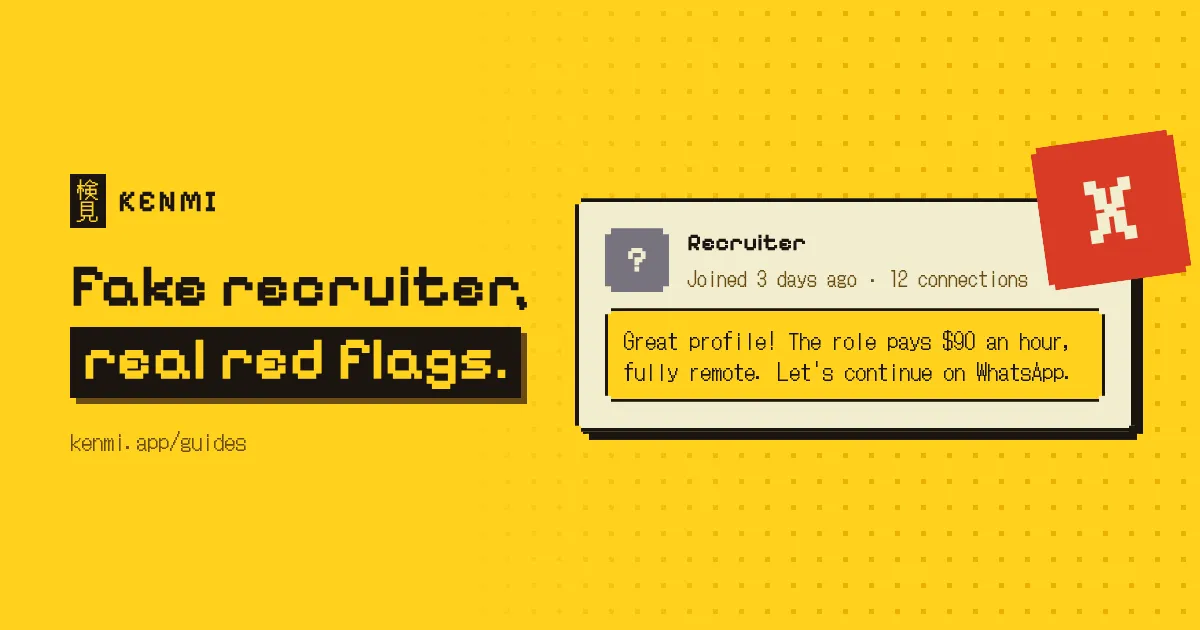
LinkedIn job scams come in two kinds. Some are outright fraud, like fake recruiters, fake companies and offers that end in a request for money or personal data. Others are ghost jobs, where real companies post roles they aren't really filling. Both cost you time, and both leave signs.
The outright scams
I've found LinkedIn harder than Upwork for landing work, and scams are part of the reason. There's a lot of noise to get through before you reach a real opening, and some of that noise is actively trying to take something from you.
The fraud usually follows a familiar shape. Watch for these signs.
- A recruiter reaches out first with a role that seems too good, with high pay, fully remote work, barely any requirements, and a lot of urgency.
- The conversation moves off LinkedIn to Telegram, WhatsApp or a chat-only "interview" with no video call.
- An offer turns up without a real interview, often followed by a request for bank details, ID or money for equipment or training.
- The company is hard to pin down. A brand new page, a handful of employees, no website, or a website that looks nothing like the business described.
If anyone asks you to pay to get or start a job, stop there. No real employer does that. Our guide on how to spot a fake job offer goes deeper on the offer stage, where most of the damage happens.
One more thing. A lot of scam posts and messages are now written with AI, so they're polished and grammatically clean. Good writing used to be a weak sign that something was legit. I don't treat it as a sign of anything anymore.
Where they find you
Scammers use every part of LinkedIn. Job posts are the obvious one, but direct messages are probably more common. A recruiter you've never heard of messages you about a role that fits your profile suspiciously well. Don't read too much into the fit. Your headline and skills are public, so a tailored message proves nothing about who sent it.
You'll also see "We're hiring, message me" comments under popular posts, often from profiles that were created days ago. And there are fake company pages that copy a real company's name and logo, with a few employees who all seem to have joined last week.
Then there are posts that link out to some other site or form, where you're asked for far more information than any application needs. That last category overlaps with something less sinister, which I'll come back to.
Any unsolicited contact deserves a few minutes of checking before you share anything.
Checking whether a recruiter is real
Fake recruiters usually fall apart quickly once you look. This is the order I'd go in.
- Open their profile and look at the history. Real recruiters tend to have years of activity, past roles and connections in the industry. A new profile with a stock photo is a warning.
- Check their link to the company. Do they list it as their employer? Do they share connections with people who actually work there?
- Find the role yourself on the company's own careers page. If it isn't there, ask why.
- Look at the email domain. A recruiter from a real company writes from the company's domain, not a free email address.
- Ask a simple question about the team, like who the hiring manager is. A real recruiter knows.
Plenty of fakes don't make it past the first two checks.
Ghost jobs, and why companies post them
Not every fake-looking post is a scam. Many are what job seekers call ghost jobs. These are posts for roles that aren't really open, or won't be filled any time soon.
My honest view is that a lot of companies post jobs for visibility. A steady stream of openings makes a company look like it's growing, keeps its name in front of people and fills a pipeline of resumes for later. I can't prove the motive for any single post, but the pattern is hard to miss once you've applied to enough of them.
The other half of it is referrals. From what I've seen, most hiring happens through internal referrals. Someone on the team knows someone, and the role is filled before the public post is even taken down. The post was real, in a sense. You just never had much of a chance.
From your side, the result looks the same as a scam. You spend hours on an application that was never going anywhere.
From experience
Many LinkedIn posts I've clicked didn't lead to the company at all. They linked out to another hiring platform that wanted me to sign up and fill in a profile first. Others were from large companies that, as far as I could tell, were posting for visibility rather than hiring. The posts that actually led somewhere were usually from smaller companies that clearly needed the help.
Posts that send you to another platform
This is the less sinister thing I mentioned. Plenty of LinkedIn posts don't lead to the hiring company. Clicking apply takes you to a separate hiring or talent platform that wants an account, a full profile and sometimes a test before you learn anything more about the role.
Many of these platforms are legitimate businesses. The catch is that the post may not be a specific open job. My guess is that some of them work mainly as a way to pull candidates into the platform's database. Before you spend twenty minutes on a sign-up, check whether the company lists the role itself, and decide whether that platform is worth joining regardless of this one post.
Picking the posts worth your time
You can't verify everything, but you can stack the odds. I lean toward smaller companies. When a small team posts a role, they usually need the person, and you can often see why, such as a specific job, a named team or a reason for hiring. Big companies can be hiring too, of course, but they're also the ones most likely to be posting for show.
Age matters. A role that's been open for months, or gets reposted again and again, probably isn't a priority for anyone. A named hiring manager or recruiter you can message is a good sign. So is a description with real specifics. Vague posts that could describe any company tend to be the ones nobody is reading.
LinkedIn's filters help with a lot of this. Our guide to LinkedIn job search filters covers the ones I'd save. Kenmi can help too. It grades each LinkedIn job you open against your profile and rules, and flags likely scams. Kenmi's letter grades show what it checks and what each grade means.
If you've found a scam
Report the post or profile from its menu on LinkedIn. Don't send documents, bank details or money. If you already did, call your bank and change any passwords you shared, today rather than tomorrow. And if the scammer used a real company's name, tell your network, because they're probably not stopping at you.
Then, honestly, use your network for the next application. Since so much hiring runs through referrals anyway, a short message to someone who works at a company will usually tell you more than the post ever will, and it might get you in the door.
Questions people ask
- Are there fake jobs on LinkedIn?
- Yes. Some are outright scams, and others are real companies posting roles they have no plan to fill soon.
- How can I tell if a LinkedIn recruiter is real?
- Check that their profile has a real history and connections at the company they claim to recruit for. Then confirm the role on the company website or with someone who works there.
- Should I pay for training or equipment for a LinkedIn job?
- No. A real employer never asks you to pay to be hired.